01 / THE SAME COUNTERTOP
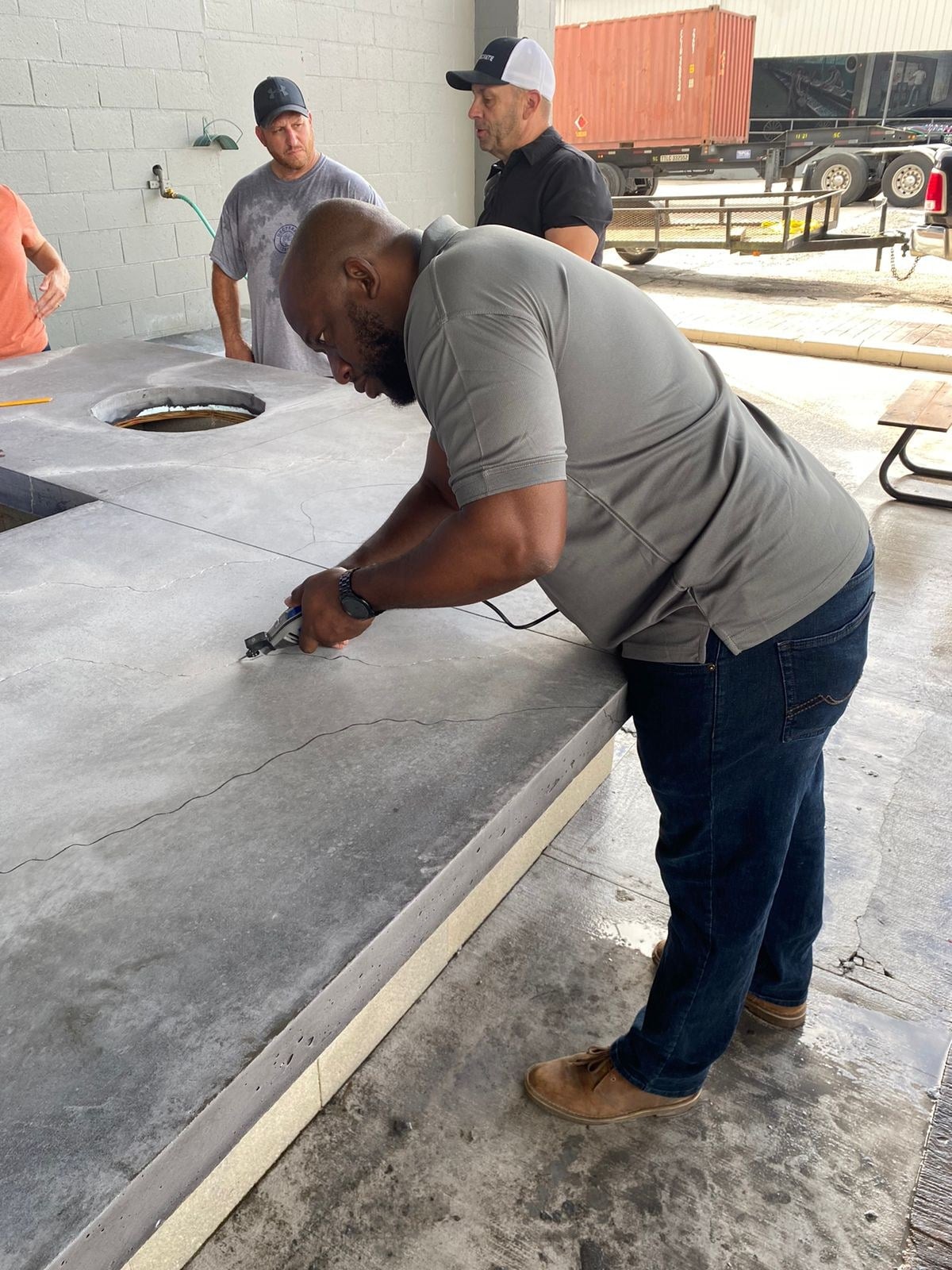
Carve the detail.
Carved detail gives this countertop its character before the blue, green and earth tones are applied.
 EXOTICRETEArchitecture · Materials · People
THE EXOTICRETE INSTITUTE / SCIENCE. CRAFT. ART.
A better built environment begins with people who know how to make it. We are building an Institute that connects Jamaican talent, material knowledge and the courage to create.
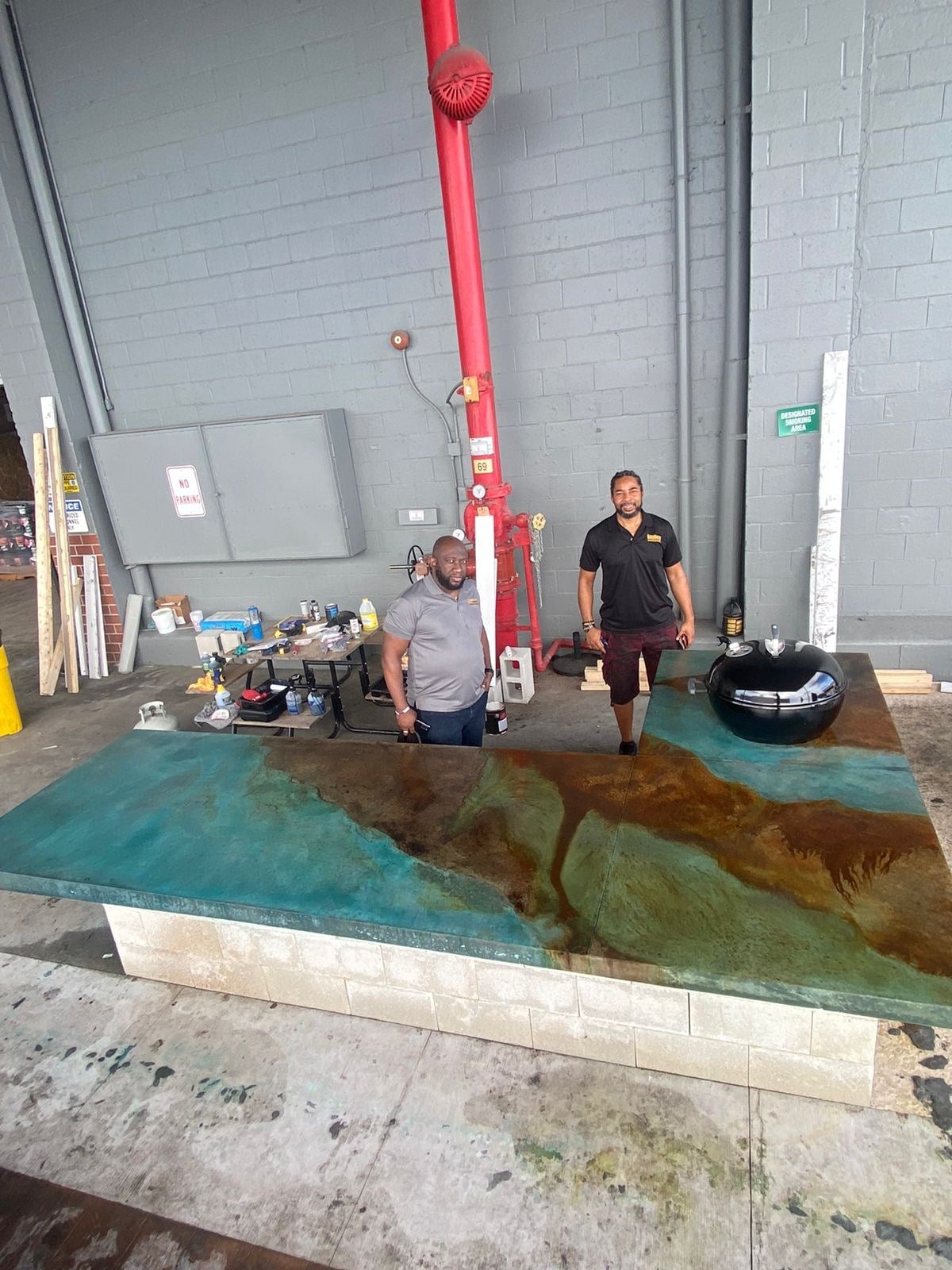
THE COUNTERTOP ABOVE / SURECRETE, SEPTEMBER 2022
Follow this same piece through carved detail, colour and finish application. The finished photograph has a story behind it.
01 / THE SAME COUNTERTOP
Carved detail gives this countertop its character before the blue, green and earth tones are applied.
02 / THE SAME COUNTERTOP
Stain introduces the blue, green and earth tones seen in the finished piece.
03 / THE SAME COUNTERTOP
Rolling the coating across the coloured countertop brings the finishing stage into view.
Good work begins with learning. The next chapter brings that practice into our own workshop.
Next: sample work in our Jamaican workshop ↓BACK IN JAMAICA / OUR WORKSHOP, JANUARY 2025
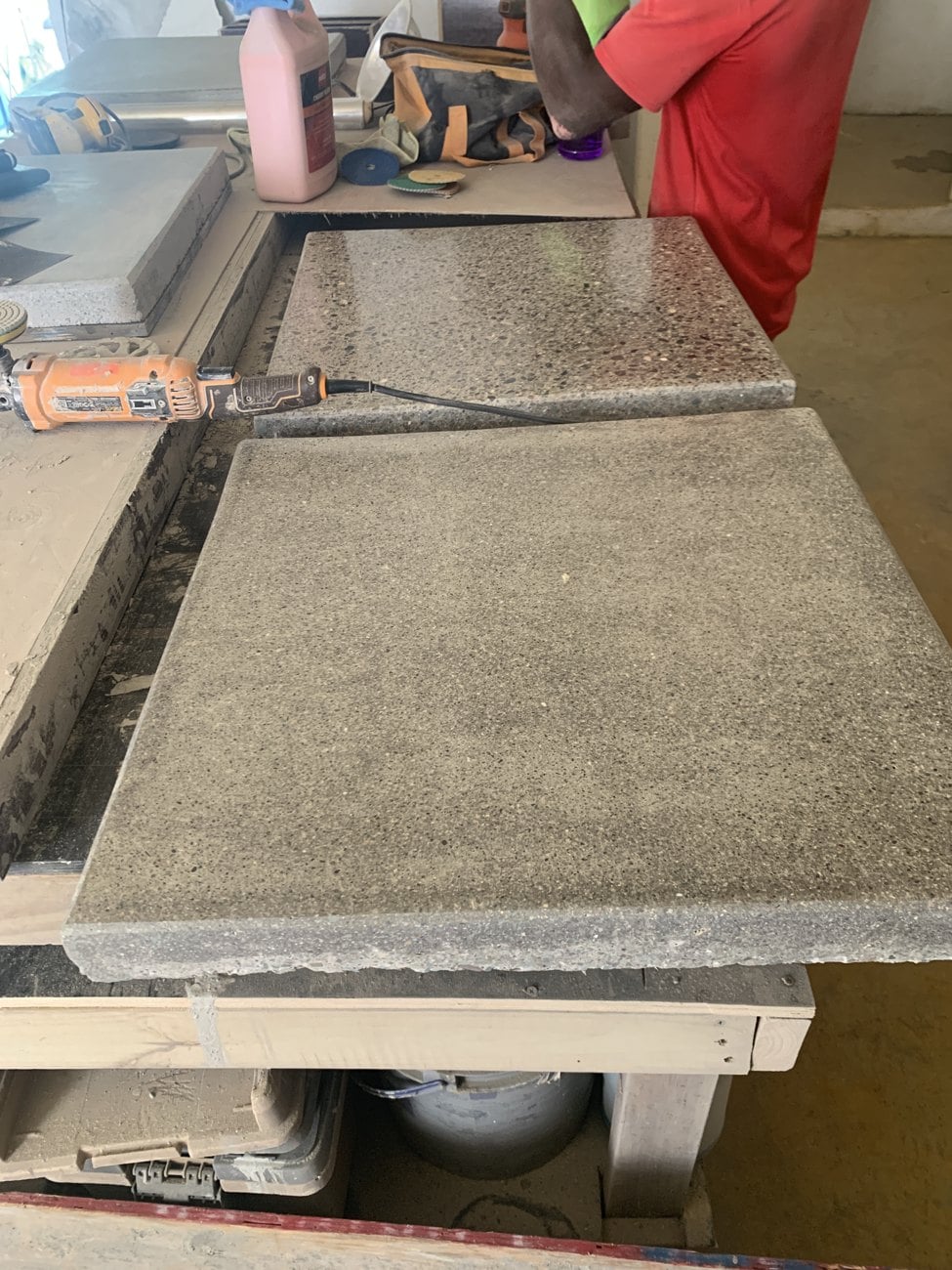
Concrete sample slabs are polished in our workshop. Small trials let us examine a surface before committing to a larger piece of work.
A DIFFERENT MATERIAL STUDY / POLISHED CONCRETE
Polishing brings the aggregate into view. Working a small sample gives us something real to examine and discuss before a larger piece takes shape.
This is the Institute’s purpose in practice: turn curiosity into skill, preserve what we learn and equip more people to make well.
Explore texture, stamping and casting ↓MORE FROM OUR TRAINING / SURECRETE, 2022–2023
A floor takes an impression. A counter face becomes stone. See the hands, tools and decisions behind the surface.
VERTICAL STONE EFFECT / NOVEMBER 2022
One counter face, two stages. Rolled texture builds the relief; hand-carved joints give the stone pattern its shape.
01 / WORK THE TEXTURE
Rolling and hand tooling create relief across the vertical face.
02 / CARVE THE STONE
Hand-carved joints define each stone shape and give the pattern its character.
STAMPED FLOOR OVERLAY / NOVEMBER 2022
On a separate floor panel, texture skins leave their impression in the overlay. Watch the lift reveal the surface underneath.
A close view of the texture left behind as the stamps are lifted.
FOUR MORE MATERIAL STUDIES / MAY 2023
Casting, flake finishes, sprayed texture and resist patterns—each demonstrated on its own training piece.
COUNTERTOP CASTING
Working the mix around a mould’s edges and openings. A separate countertop exercise from May 2023.
FLOOR FINISH APPLICATION
Flakes are scattered across a coated demonstration slab. Watch the coverage build.
SPRAYED SURFACE TEXTURE
A hopper gun applies texture to a demonstration slab. The camera follows the application and the surface it leaves.
RESIST REMOVAL
Lifting the resist exposes the planned diagonal lines in the textured floor panel.
These are records of our own learning. The Institute’s planned programmes will turn that commitment to practice into a structured pathway for more makers.
See what we plan to teach ↓WHY THE INSTITUTE MATTERS
Every project teaches something. The Institute gives that learning a place to be questioned, recorded, taught and improved.
Develop people who can explain a decision, prepare properly, make with precision and recognise when a result needs correcting.
Connect Jamaican tradespeople, designers, students and industry with practical learning and material investigation rooted in our conditions.
Turn useful lessons into better teaching, better installation methods and, through testing, better products made here.
FIVE SCHOOLS / ONE CONNECTED PURPOSE
Science, craft and art run through every school. The intended offer connects practical ability with design judgement, material understanding and responsible business.
Decorative plaster, microcement and architectural finish systems. Learn to read the substrate, prepare a surface, build a sample and evaluate the finish.
Planned practice: preparation exercises, application panels, finish comparisons and assessed installation tasks.
Move between a drawing, a mould and a physical object. Explore cast forms, furniture, precast elements and sculptural work with attention to use, proportion and repeatability.
Planned practice: model-making, mould development, prototypes, finishing and integrated design-and-make projects.
Investigate how materials behave together and under Jamaican conditions. Substrate compatibility, local material possibilities and tropical exposure belong in the same conversation.
Planned practice: labelled samples, controlled comparisons, batch records, observations and evidence-led proposals for the next trial.
Use drawings, colour, visualisation and digital tools to turn an intention into something another person can understand and make.
Planned practice: design briefs, presentation studies, digital fabrication exploration and accountable use of AI, with human judgement at the centre.
Build the judgement that sustains good work: estimating, contracts, quality control, client service, leadership and business finance.
Planned practice: costed briefs, quality records, handover exercises and decisions that connect workmanship with a viable business.
Programme development is under way. Course dates, fees and entry requirements will be announced when each offer is ready.
THE PERSON BEHIND THE WORK
We aim to develop thinkers, creators, makers and leaders. Four qualities guide that work.
Explain the material, the method and the decision.
Demonstrate sound work through practice and assessment.
Work with integrity, care and the humility to improve.
Use your ability to strengthen people, places and the profession.
THE FIRST PRACTICAL STEP / PLANNED PILOT
The first planned pilot brings decorative plaster and cementitious systems together, moving from foundations to an integrated practical project.
Establish each learner’s baseline, introduce the materials and agree the task.
Practise decorative plaster and cementitious systems, with feedback and assessment.
Plan and complete a practical task, record the work and prepare its handover.
Review demonstrated ability, identify gaps and agree the next development step.
A seat in the workshop is a beginning. Progress will be judged through task records, labelled samples, photographs, observed work and feedback—not attendance alone.
FROM LEARNING TO JAMAICAN INNOVATION
Our direction connects education with applied research and manufacturing. A question from a site can become a recorded trial; a useful result can improve an installation method, a teaching exercise or a product under development.
We plan to build shared Academy studios and fabrication spaces, testing resources, a materials library and design archives in stages. They will support the five schools and preserve knowledge that the next maker can build on.
Explore the Jamaican materials agenda ↗THE DIRECTION / BUILT IN STAGES
Each stage depends on teaching readiness, suitable facilities, evidence from delivery and the resources to sustain it.
Prepare instructors, establish the learning environment and deliver the first assessed practical pathway.
Refine courses, develop trainer and assessor capacity, and connect the offer to industry needs.
Expand specialisms, applied research and regional participation as the Institute’s capability grows.
Enrolment is not yet open. External qualifications and academic partnerships remain development goals; we will identify confirmed arrangements when they are in place.
MEK WE BUILD THE NEXT GENERATION
Tell us what you want to learn, teach or investigate. We welcome conversations with tradespeople, designers, students, employers and potential research collaborators.
Discuss training or collaboration